Gamification vs Game Thinking
Why the Former Is Fine and All, While the Latter Leads to Deeper Understanding

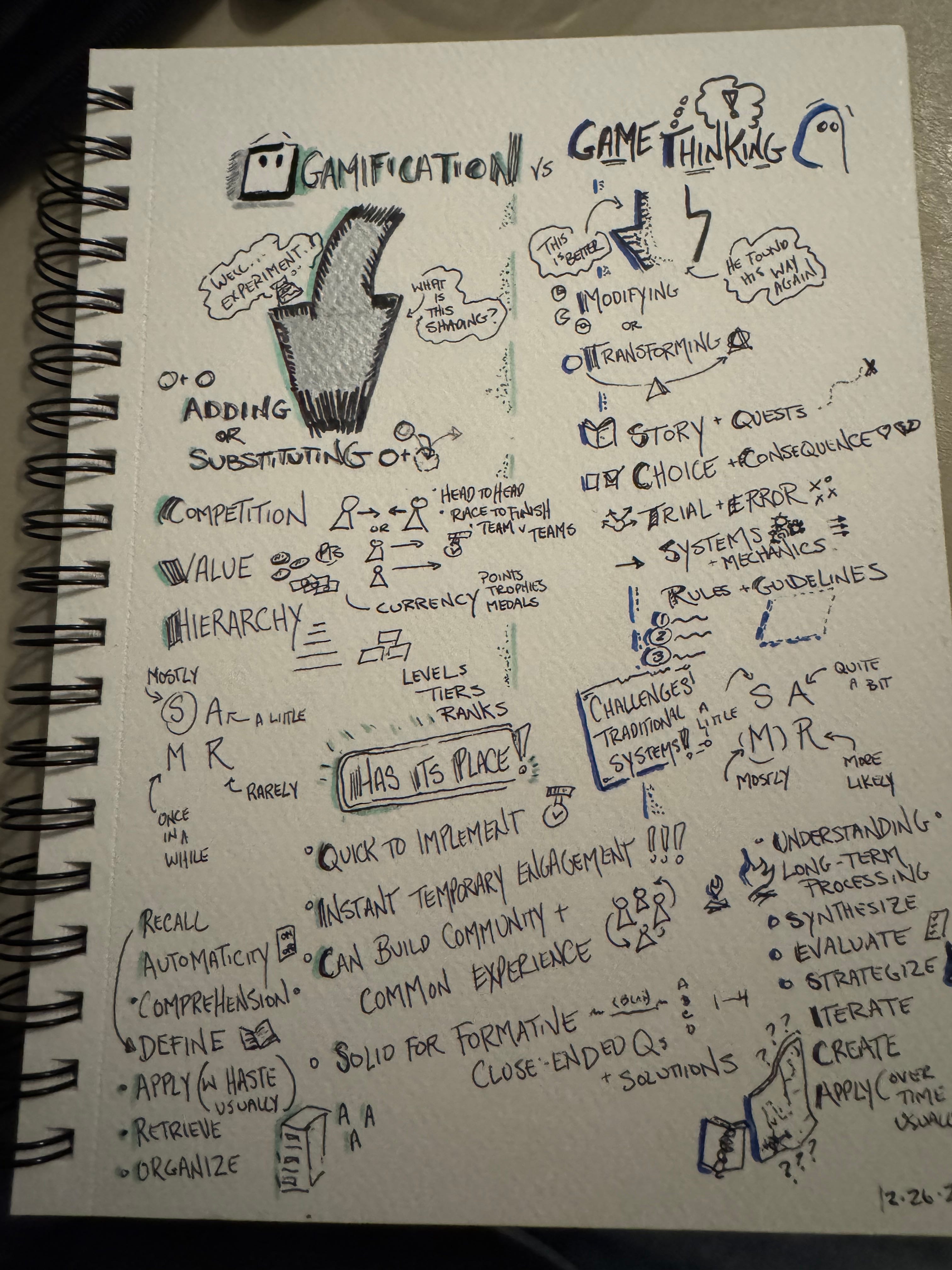
Gamifying the classroom has been around for as long as there have been spelling bees, bonus points, and newspaper trivia contests. For the record, I absolutely crushed at the NewsGame at Garland Street Middle School in 7th and 8th grade. You can hear me talk to my eighth grade social studies teacher, Rich Kimball, on his Maine Public radio show, Northeast Corner, here.
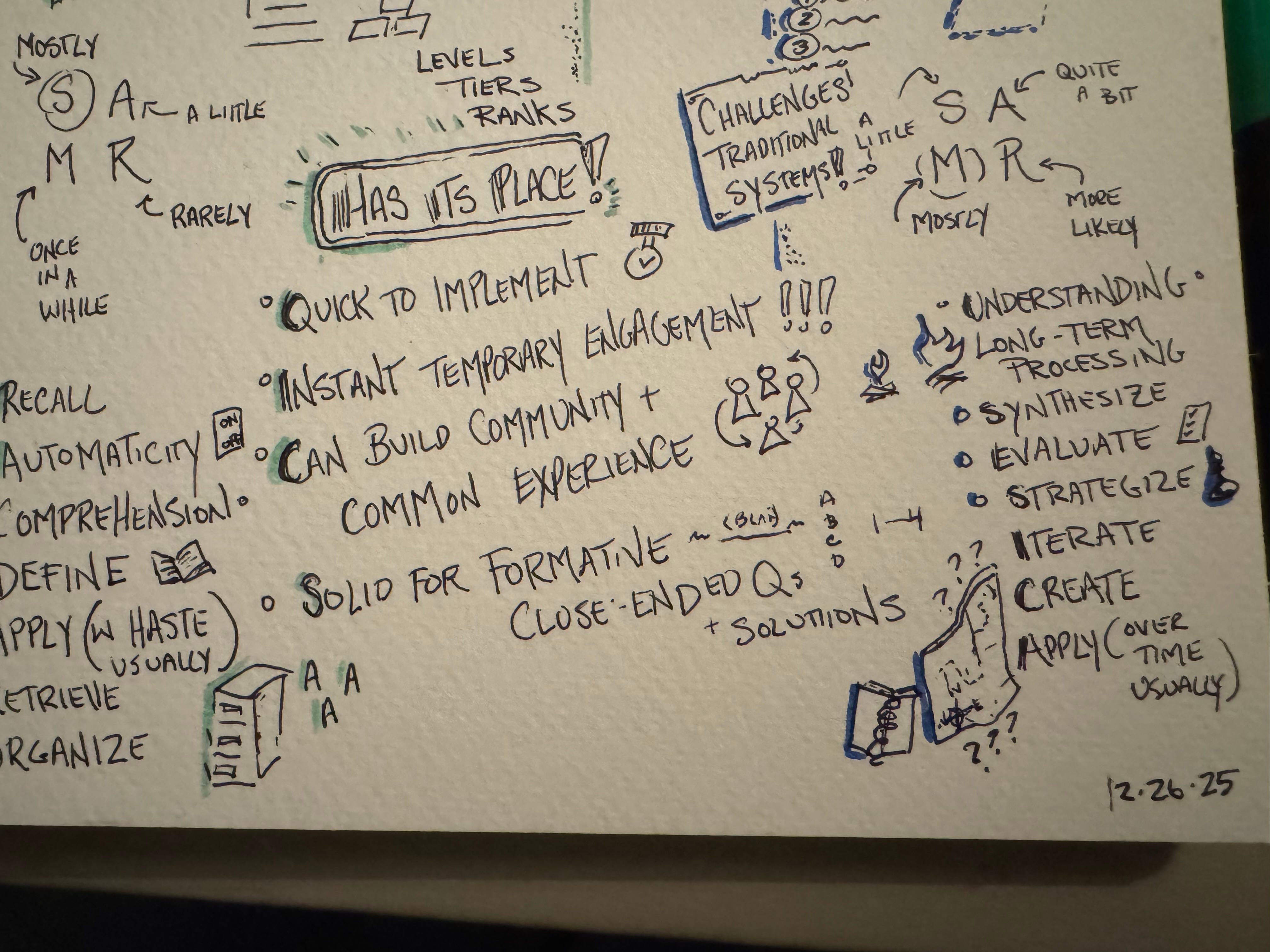
Educational technology just cranked the whole thing up to 11 with the Kahooting of it all in the 2010s. Kahoot and its contemporaries have provided tremendous opportunities in the classroom for quick-to-implement formative assessment. Bringing competition, hierarchy, and currency into the classroom has potential for growing community and culture around a common experience. Taken with a tongue planted firmly in cheek and with a very careful inclusion strategy for more introverted, less social, or simply neurodivergent learners, tournaments, teams, and leagues built around these gamified learning tools can also bring joy and laughter.
These formative gamification tools create semantic and tactile connections in the ol’ dome piece, associating knowledge with physical, social, and communal experience at a particular moment in time. These are good things for encouraging rapid recall, expressing knowledge of close-ended, true/false, this/that factual information, and sorting buckets of facts and figures into learners’ ever developing cognitive systems Those internal cabinets and file folders look a lot better when learners have multiple reliable opportunities to access them and shuffle the contents around.
The trouble surfaces when these formative experiences are where we stop and our summative assessments just take on the look of multiple choice, fill-in-the-blank, true/false and rapid-fire matching. Yes, I know that’s what most standardized tests and even responsive growth-oriented tests look like and how many of our schools are measured by gatekeepers. I can relate only too well . . . grumble, grumble, frickin’, frackin . . . When we are talking summative assessments, we really want our learners getting after that higher order thinking of synthesis, evaluation, strategy, and creation.
For this reason, I tend to champion game thinking in learning spaces.
I certainly didn’t coin the term game thinking. Among the people who have done very cool work in this universe is game design and engagement specialist Amy Jo Kim who lays out her perspectives on game thinking in her fantastic work and book. She applies her take on game thinking to how worlds of business, communication, and innovation may benefit from understanding video game design and it’s well worth your time to go exploring.
At the risk of opening myself up to more exceptions and “but-what-about’s,” but to make my case stronger for education contexts, I’ve developed a broader view of game thinking. By unpacking team sports to tabletop war gaming, I’ve identified what I see as five essential elements for an engaging game-based learning experience.
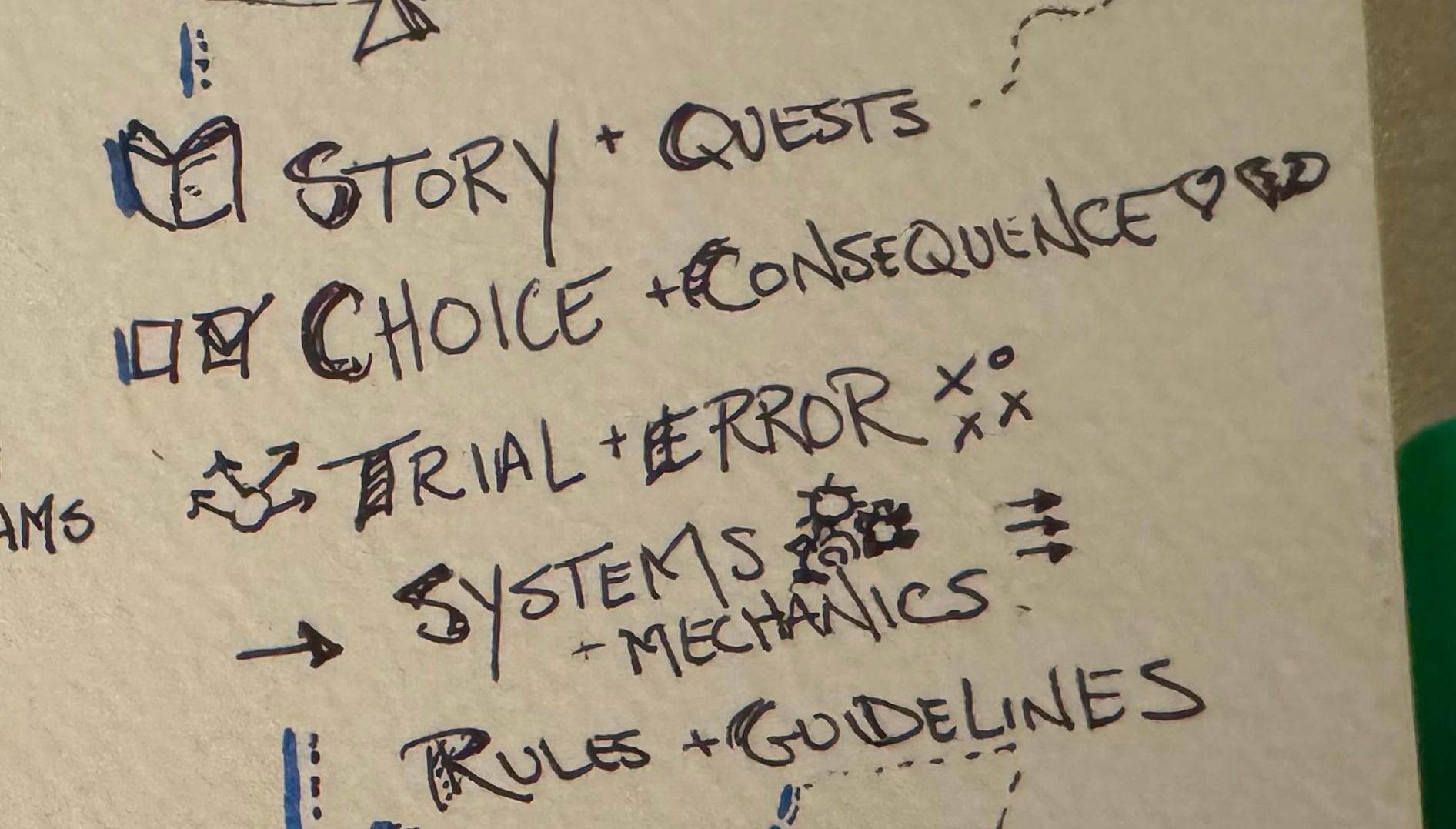
At first glance it may seem like just semantics and that I’m just trying to be clever. I assure you, I’m not that clever. Evidence: I just used the word ‘semantics’ twice in the same post. I posit that game thinking is a posture akin to design thinking, where learners and educators may view problems, challenges, and knowledge through a particular mindset.
In the case of a design thinking mindset, we approach problems from a place of human-centered empathy that suggests we best meet unfilled needs when we create with intention, practice “Yes, and…” collaboration, bias to action, and lean into discomfort a.k.a. the squish.
When we shift to a game thinking posture, we approach problems from a place of human-centered engagement that suggests deeper understanding emerges when we embark on journeys and quests, encourage trials and errors, provide choices and consequences, apply systems and mechanics, and function within rules and guidelines.
Now, what might game thinking look like in practice? It could certainly look like designing games to demonstrate understanding. I’ve taken that tact many times over and it is highly rewarding if also time demanding. There are other possibilities to consider that brings even more game thinking sensibilities into any number of contexts.
What if we were to structure a social studies instructional unit in a way more similar to Campbell’s archetypal heroic cycle than to XYZ textbook publisher’s traditions? How might this transform the journey to learning target proficiency to something resembling Link’s quest for the Ocarina of Time or Diana Taurasi’s campaign for basketball dominance?
How might we structure formative learning experiences in physical sciences where learners are encouraged to try and try and try again — each failure opening up a little more knowledge. How might this reflect the experience of chess players and football players learning more about their opponents’ defenses with every play?
Where might English language arts classrooms find added value in authentic choice making opportunities that lead to consequences and outcomes for those choices? How might committing to a particular audience for a piece of writing lead learners to to produce deliverables on a true endgame deadline or to future opportunities to publish their work?
Who might benefit when a pre-Algebra class applies a defined set of systems and mechanics that reflect the strengths and challenge the weaknesses of its learners? How might seating arrangements, practice sets, guided instruction, and word problems resemble the action-selection of a competitive game of Catan or a collaborative game of Pandemic?
And why might a robust set of rules and guidelines better serve a group of young adolescent learners struggling through a series of health lessons that may seem irrelevant, uncomfortable, neither, or both depending on the individual? What might it look like to guide those learners to toward a set of expectations that goes beyond the typical, “respect each other” and “one speaker at a time” niceties?
Each of the above possibilities would benefit from progress tracking and meaning reflection. Game players only improve their outcomes when they think about what they have done, what has worked, what hasn’t, and make a plan for the next endeavor. And we know that game players who find themselves in zone of proximal development — from having done that reflection and planning — are more likely to stay engaged as they grow in their button clicking, ball tossing, and pattern recognizing skills.
None of this is easy and to be certain, I’m not advocating for an abandonment of gamification altogether. It has its place. Too many of us educators have gotten comfortable in that place, though. Think about how amazing the next level might be if we headed there together.